

Our mission is to bring the conversations that matter into the classroom, with physical tools that prepare students for the future.
Some of the most important things a young person needs to know are never taught in a lesson. Many girls leave school without understanding what is happening in their own bodies, and many students use AI and digital tools every day without ever discussing what that means. They can look things up, but they are often unsure who to ask, and they assume they are on their own. Most of the time, many others are asking the same questions.
We build card decks, facilitated sessions and classroom tools that open those conversations. Each one pairs a question with a real-life case and a prompt that gets students talking, with the teacher in the room and no screen in the way. The medium is always physical. The outcome is always human.
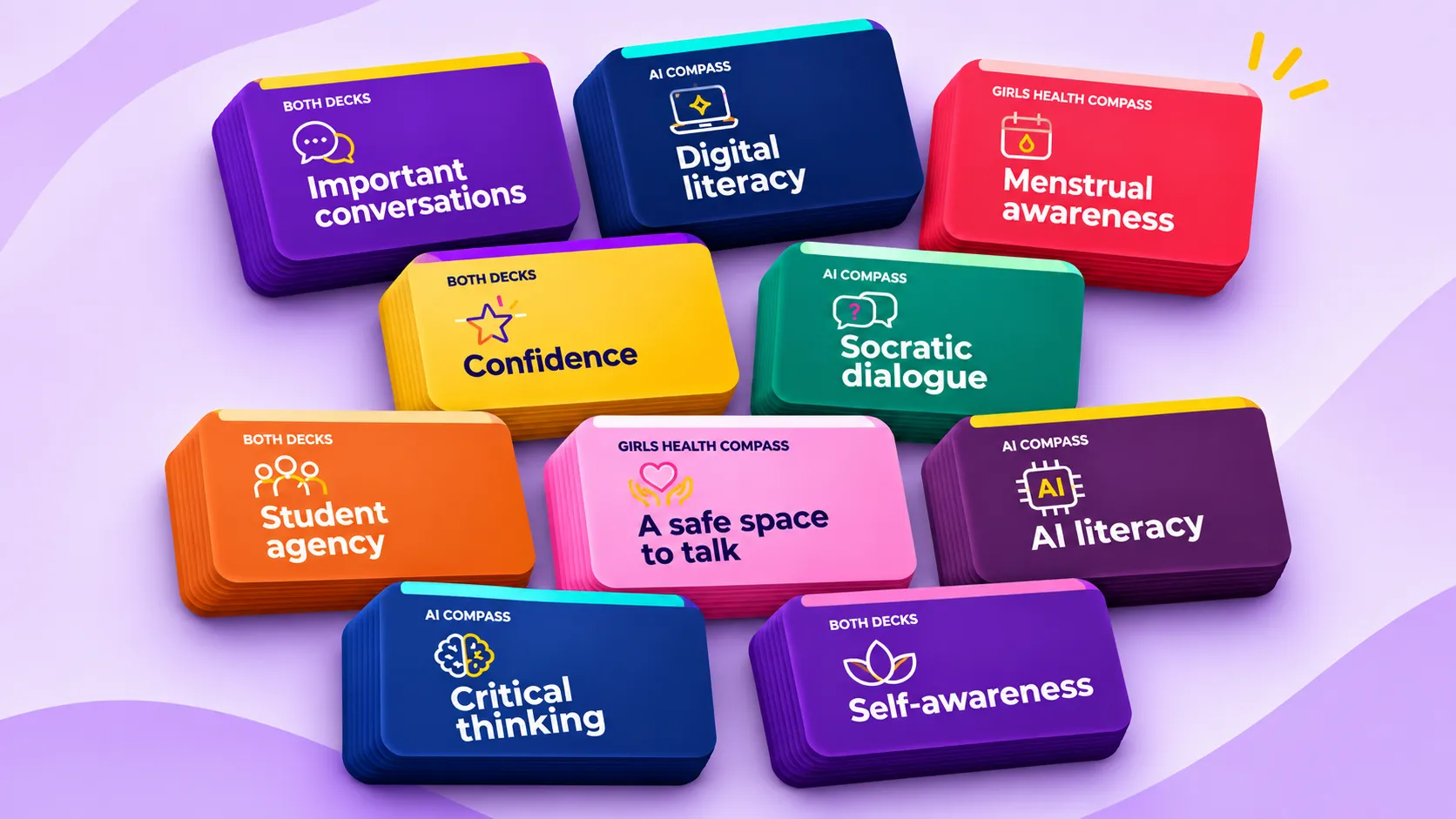
We bring teachers and students back into the room, human to human. Cards replace screens and textbooks, so every student holds a prompt, a real-life case and a conversation trigger in their own hands, and shares what they think with their peers.
We call both decks compasses because they do the same job: they give young people a sense of direction. A compass doesn’t tell you where to go. It helps you understand where you are and decide for yourself.

A world where every student has the foundational knowledge to understand themselves, and the conversations to make sense of it.
We want every young person, wherever they live, to have the foundational knowledge they need to understand themselves and the world around them. It is the minimum, and too many students still don’t have it.
Because our tools are physical, they can travel anywhere. A deck can be posted to a classroom in Reykjavík, Nairobi, New Delhi, Boston or São Paulo, and arrive in days. We translate them into local languages too, starting with Icelandic, so that students can have these conversations in their own words.
The students we reach today will become the parents and teachers of tomorrow. When young people grow up informed and able to talk openly about their bodies, their technology and their choices, they pass that on. We want to help build a generation that explains things to their children, where earlier generations were often left to work it out alone.
We will keep building more analog, practical and fun tools that bring real conversations into classrooms.
Can’t find your answer here? Reach us directly at
hello@channelwiseeducation.com
Students are surrounded by AI every day, but understanding comes through conversation. AI Compass guides learners through three simple steps that build awareness, critical thinking, and responsible AI use.
Students are surrounded by AI every day, but understanding comes through conversation. AI Compass guides learners through three simple steps that build awareness, critical thinking, and responsible AI use.
Students are surrounded by AI every day, but understanding comes through conversation. AI Compass guides learners through three simple steps that build awareness, critical thinking, and responsible AI use.
Students are surrounded by AI every day, but understanding comes through conversation. AI Compass guides learners through three simple steps that build awareness, critical thinking, and responsible AI use.
The AI Compass is designed for ages 14 and up, mainly secondary students. Depending on your curriculum and how much your students already know about AI, it can also work well with 13-year-olds and teenagers in general.
The Girls Health Compass is designed for girls from around 12. Every girl’s journey is different, and some start earlier. We believe those girls should be part of the conversation too, so we advise teacher discretion and school autonomy, and we recommend involving parents where appropriate, so no student who starts early is left behind.
No. Our decks are screen-free, analog tools with no login, no setup, no algorithm and no data collection. Students can work in pairs, in small groups, group against group, student against student, or as a whole class with the teacher. The aim is simply to create an environment for conversation.
Each card has a prompt that gets students thinking, a real-life case that gives it weight and perspective, and a conversation trigger that keeps them talking. Students answer in their own words and listen to each other. Teachers facilitate and encourage Socratic dialogue, depending on the topic.
No. Every deck comes with clear guidelines and a checklist, and the AI Compass includes 13 gamified session formats. A teacher can run a strong conversation with no preparation. The formats and guidelines are emailed to you when your order is paid.
A teacher knows their students best, so you are welcome to adapt the formats or create your own. They are simply formats we have tried and want to share.
You can start with a single lesson. There is nothing to install. Decks are sent as a tracked parcel, so allow time for delivery depending on your location. Once it arrives, you can begin straight away.
It’s up to you. You can use the cards across a whole semester or year, for example once a week in a Theory of Knowledge, health or life skills class, working through a different category or card each time. In a 60-minute session you might cover one category, or two. The goal is to get as much as possible out of every conversation, because that is what keeps students thinking about these topics.
The decks are designed to fit into lessons schools already teach, such as Theory of Knowledge, life skills, personal development and health classes. They are not tied to one national curriculum. They support general-knowledge conversations that we believe students should be part of, as preparation for their future and to understand where they stand in their own experiences.
No. It is a conversation tool that shares clear, foundational information. It encourages girls to talk to each other and to share their experiences in a room where they feel supported, and to talk to a trusted adult, school nurse or doctor about anything that worries them. It is not a substitute for medical care. It helps girls learn about wellness, hygiene, their bodies and their menstrual cycle.
No. The decks are physical, with no accounts and no logins, so there is nothing to collect from students. Everything stays between the teacher and the students in the room, and Channelwise does not receive any information back.
The AI Compass is available in English and Icelandic. We plan to add more languages, and we’ll announce them on our website.
Yes. Most libraries start with three decks. We also offer a discounted School Pack of seven decks.
We’d love to hear from you. Fill in the form or reach us directly.
hello@channelwiseeducation.com